
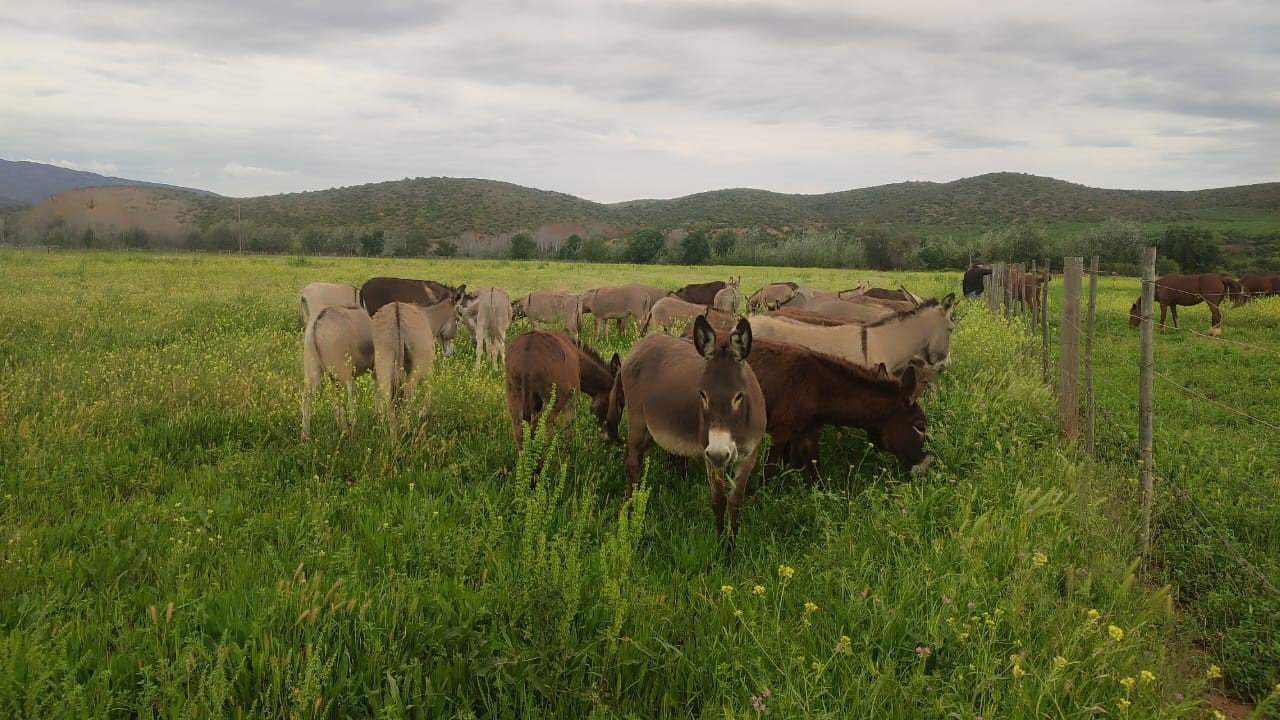

Thirty-two free-roaming donkeys have been brought to safety after a complex rescue operation in Wupperthal, deep in the Cederberg Mountains of the Western Cape, but eight animals from the original herd remain missing.
The Karoo Donkey Sanctuary was alerted last week after members of the local community rounded up a herd of 40 donkeys.
When the rescue team arrived on Saturday, 12 September, it found that eight had disappeared overnight.
Plans to return for the missing animals are currently on hold because of the logistical challenges of reaching the remote area.
Underweight mares and young foals found
The condition of some of the animals concerned rescuers.
The herd included visibly underweight mares with young foals at foot and 18 intact stallions. Some of the vulnerable mares may also be pregnant.
“What we discovered in this remote mountain valley was deeply concerning,” said Jonno Sherwin, Founder and CEO of Karoo Donkey Sanctuary. “We could not simply turn our backs on this fragile herd. We had to help.”
Donkeys have a long history in Wupperthal, which was founded in 1830 as South Africa’s first Rhenish mission station and was later entrusted to the Moravian Church.
For generations, the animals helped carry people and produce through the area’s rugged mountains where other forms of transport struggled with the terrain.
Now, it was the donkeys that needed help.
A 14-hour journey to safety
With assistance from the Clanwilliam Animal Welfare Society (CLAWS) and New Turf Carriers, the 32 donkeys were transported from the mountains to Clanwilliam before beginning their journey to the sanctuary.
The trip took approximately 14 hours, with the animals arriving safely at around 9pm.
Their shelter had already been prepared, allowing carers to settle the herd and assess their immediate needs.
The following morning, the donkeys were able to step outside into the Karoo sunshine to graze and explore their new surroundings.
Sanctuary raises concerns over donkey skin trade
The Karoo Donkey Sanctuary says donkeys across South Africa face threats including neglect, commercial slaughter and demand for their skins.
Donkey hides are used to produce ejiao, a traditional Chinese product made using collagen extracted from the skins.
The sanctuary says vulnerable herds risk disappearing into a largely hidden supply chain.
“By bringing them into sanctuary, we are not only saving individual lives,” said Sherwin. “We are ensuring that these donkeys will never be sold, slaughtered or reduced to the value of their skins.”
R63,000 needed for rescued stallions
The rescue operation is not over once the animals reach safety.
The sanctuary now needs to raise R63,000 to fund a gelding clinic for the herd’s 18 intact stallions.
Each procedure will cost R3,500, with the gelding intended to prevent further breeding and help the sanctuary manage the herd safely.
Members of the public who want to support the rescued donkeys can make a once-off donation or become monthly supporters through the sanctuary’s Long Ears Club.
Once-off donations
Karoo Donkey Sanctuary
Standard Bank
Current Account: 30 087 404 9
Branch Code: 051001
Reference: Rescue + your name
To join the Long Ears Club, email fund@karoodonkey.org.
For now, 32 members of the Wupperthal herd are safe, while the fate of the eight donkeys that disappeared before rescuers arrived remains unresolved.






Leave a comment